
If you spend time with babies or toddlers, you already know their favorite way to learn about the world: play. They taste, poke, wiggle, explore, copy you, repeat the same thing fourteen times, and break into song at unexpected moments. And believe it or not, that’s exactly how their brains are designed to grow.
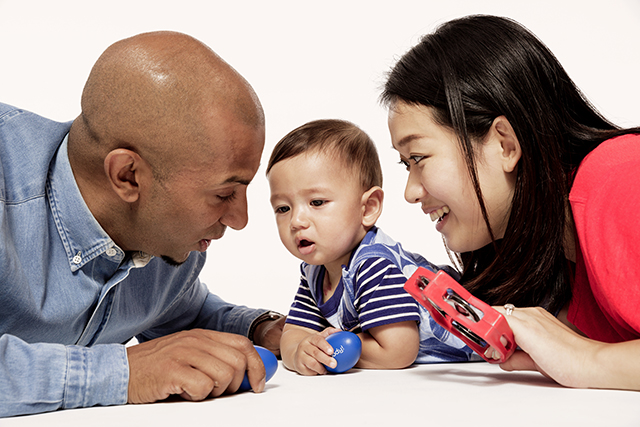
But here’s the part we sometimes forget: kids play best when we, their favorite grownups, play with them. Not by entertaining them endlessly, but by being curious, responsive, a little silly, and willing to join their world for a few minutes at a time.
Let’s take a look at why play is such a superpower for young kids, how the science backs it up, and why Tam Tam leans so heavily into informal musical play in every class.
Play: The Brain’s Favorite Way to Learn
The first five years of life are packed with brain growth. Neuroscientist Lise Eliot, in her wonderful book What’s Going On in There?, describes this time as a huge burst of wiring and rewiring. Kids’ brains build connections based on experience, and play is one of the richest experiences they get.
When a child plays, they’re actually practicing:
- Paying attention
- Remembering routines and patterns
- Working through frustration
- Learning new words
- Figuring out how people respond
- Using their imagination
- Moving and coordinating their bodies
The Harvard Center on the Developing Child says it simply: playful interaction helps build the architecture of the brain. It’s all happening during that “just playing” time.
Why Playful Grownups Matter More than Fancy Toys
If you’ve ever bought a complicated toy only to have your toddler play with the box… you’ve already seen the truth: kids don’t need expensive stuff. They need you.
Researchers call this serve and return. Your child makes a sound or movement, you respond, they respond back, and suddenly you’re in a tiny, joyful conversation. This back-and-forth is the foundation of language, social skills, emotional regulation, and connection.
Grownups can support play in simple ways:
- Follow your child’s lead (even if that means pretending the laundry basket is a rocketship, or a garbage truck backing up).
- Add one little twist or challenge to keep it interesting.
- Keep things light: laughing together is powerful fuel for learning.
- Build small rhythms or rituals (“We always sing a shoe-putting-on song!”).
You don’t need to be perfect. You just need to be present and playful.
Why Musical Play Is Extra Powerful
Music is one of the most “whole-brain” activities kids can do. It mixes movement, patterning, emotion, language, memory, and social connection — all at once. Singing, dancing, clapping, shaking, and bouncing together give children:
- A stronger sense of rhythm and timing
- Rich language input
- Practice taking turns
- Tools for calming and emotional regulation
- Bonding time with their grownups
Research backs this up: studies show that when young children actively participate in music — not just listen — this boosts verbal skills, attention, and even social cooperation. Singing with a caregiver is especially powerful. It comforts, organizes, and gives babies and toddlers a sense of shared joy.
And of course, musical play is fun. When something feels good, kids do more of it, which means more learning.
How Tam Tam Supports Playful, Developmentally Appropriate Music Learning
At Tam Tam, we build our classes around informal musical play because it lines up beautifully with how young children actually learn. You’ll notice that our classes are filled with:
- Live music (no microphones nor performers)
- Simple instruments
- Repetition and pattern
- Movement and dancing
- Playful routines
- Space for children to explore in their own way
We always model for grownups, too, because we know kids learn far more from your participation than from anything we do at the front of the room. When you sing, move, and play alongside your child, you’re giving them exactly the kind of interaction their brain needs to thrive.
In short: Tam Tam strengthens the playful bond between you and your child. And that bond is the real engine of early learning, musical or otherwise.
Easy Musical Play Ideas for Home
Want to bring more play into your daily routines? Try:
- Singing your way through transitions (“Let’s all zip our coats…”)
- Making a kitchen band with pots, spoons, or shakers
- Dancing freeze games
- Copying your child’s rhythms or silly sounds
- Turning a favorite song into a call-and-response game
These little moments add up in big ways.
References
- Eliot, Lise. What’s Going On in There? How the Brain and Mind Develop in the First Five Years of Life. Bantam Books, 1999.
- Center on the Developing Child at Harvard University. “Serve and Return Interaction Shapes Brain Architecture.”
- Trainor, L. & Ferguson, C. “The Development of Musical Skills and Their Importance to Early Childhood Learning.” Annals of the NY Academy of Sciences, 2015.
- Trehub, S. et al. “Parent–Infant Singing: A Basis for Infant Learning and Bonding.” Infant Behavior & Development, 2013.
- Kirschner, S., & Tomasello, M. “Joint music making promotes prosocial behavior in 4-year-olds.” Evolution and Human Behavior, 2010.