
How young children learn music through singing, movement, play, listening, repetition, and connection, and why the grownups around them matter.
If you’ve ever watched a young child respond to music — bouncing when they hear a familiar song, clapping along, babbling, dancing, or suddenly singing a phrase you’ve never heard them sing before — you’ve seen the beginnings of musical learning.
But young children don’t learn music in the same way older children or adults do. They don’t need to sit still while someone explains music to them. They also don’t need to perform.
Young children learn music by living in a musical environment. They listen, watch, imitate, move, experiment, repeat, play, make sounds and observe other people making music.
This is the foundation of participatory music-making: an approach to early-childhood music education in which children are active participants in the musical experience rather than an audience watching someone else perform.
Participatory music-making is one of the most meaningful ways young children can experience music. At Tam Tam, family music classes for children from birth through age five bring children and their grownups together to sing, move, listen, play instruments, explore, and make music as a community.
Children aren’t an audience. Grownups aren’t spectators. Everyone is part of the musical circle.
At a Glance:
Participatory music-making is an approach in which children actively experience and explore music through their voices, bodies, movement, instruments, attention, and imagination.
In an early-childhood setting, it means:
- Children participate rather than simply watch.
- Grownups sing, move, play, and model musical behavior alongside children.
- Children are free to participate, and they do so in developmentally appropriate ways.
- Listening and observing are recognized as meaningful forms of participation.
- Singing, movement, instrument play, repetition, and exploration are central to the experience.
- The goal is musical growth and engagement, not performance.
- Music continues beyond the classroom and becomes part of everyday family life.
At Tam Tam, we put these principles into practice through live, research-based Music Together® classes for babies, toddlers, preschoolers, and their grownups.
What Is Participatory Music-Making?
The word participatory is important.
A performance asks an audience to watch and listen. Participatory music-making invites people to join in.
For young children, joining in might mean singing a song, bouncing on a caregiver’s lap, dancing around the room, playing a drum, copying a movement, listening carefully, watching another child, experimenting with a sound, or simply taking in what is happening.
There isn’t one correct way to participate. A baby may stare intently at a singing grownup. A toddler may dance without following the teacher’s movements. A preschooler may sing every word. Another child may spend several weeks watching before suddenly joining in. All of these can be meaningful musical experiences.
The purpose isn’t to make every child perform the same action at the same time. The purpose is to create a rich musical environment in which children can explore music, absorb musical patterns, develop their own musical responses, and gradually discover themselves as music-makers.
Why Does Participation Matter?
Young children learn through relationships and experience. They learn by watching people they trust, by trying something, repeating it, changing it, and trying again, and by experiencing ideas in many different contexts over time.
Music is particularly well suited to this kind of learning because it naturally combines sound + movement + language + rhythm + attention + emotion + social connection. A child doesn’t have to understand a lesson about rhythm in order to experience a steady beat. They don’t need to be told that a song has a particular melodic pattern in order to hear that pattern repeatedly. They don’t need to be instructed to “develop musicality” in order to start moving when a familiar song begins.
The experience comes first. Understanding and expression develop over time.
That’s why an effective early-childhood music environment doesn’t need to look like a traditional lesson. It can look like singing, dancing, repetition, laughter, experimentation, and play.
The Six Principles of Participatory Early-Childhood Music-Making
1. Participation Over Performance
The goal of early-childhood music-making isn’t to prepare a child for a recital. It’s to help children experience music as something they can do.
There is no audition. No expectation that every child will sing on cue. No need for children to demonstrate what they’ve learned for the adults in the room. Instead, we create opportunities for children to experience themselves as capable participants.
A child may sing, listen, dance, watch, experiment with an instrument, or do something completely unexpected. The musical experience makes room for all of it. Participation comes before performance.
2. Modeling Over Instruction
One of the most important people in a young child’s musical environment is not the teacher. It’s you.
- Children watch the grownups around them constantly.
- When you sing, your child sees someone they love making music.
- When you move to the beat, your child sees that music can live in the body.
- When you pick up an instrument and experiment with it, your child sees that musical exploration is something ordinary people do.
You don’t have to explain any of this. Your participation is the lesson.
That’s why Tam Tam family classes are designed for grownups as well as children. We don’t want parents and caregivers watching from the sidelines. We want them in the musical circle.
And you absolutely do not need musical training to participate. You don’t need to sing in tune, keep perfect rhythm or know every song. You simply need to join in.
3. Exploration Over Correctness
Young children need opportunities to explore.
A toddler banging on a drum isn’t necessarily trying to reproduce a rhythm correctly.
They’re discovering:
- What happens if I hit it softly?
- What happens if I hit it hard?
- What does this sound like?
- Can I make the sound again?
- Can I make a sound while everyone else is making music?
Musical development grows through these experiences. That’s why participatory music-making leaves room for experimentation. We invite children to explore songs and instruments rather than requiring them to reproduce an adult’s behavior perfectly.
There is room for mistakes, for trying again, for doing something differently. Curiosity is part of musical learning.
4. Repetition Over Rushing
Young children often need to encounter a song many times before their learning becomes visible. The first time, they may listen. The next time, they may recognize it. Later, they may move when they hear it. Eventually, they may sing part of it. And one day, you may hear them singing the whole thing while playing in another room.
This is one reason repetition is so important in early-childhood music education. A familiar song becomes something a child can return to, explore, and make their own. At Tam Tam, songs are revisited throughout a collection rather than treated as something to learn once and move on from. Familiarity creates opportunities for deeper participation.
5. Developmentally Appropriate Participation
A six-month-old and a four-year-old experience music differently. So do a shy toddler and an exuberant preschooler.
Developmentally appropriate music-making doesn’t require every child to respond in the same way. Instead, it creates an environment rich enough for children at different stages to find their own entry points.
This is one reason mixed-age music-making can be so valuable. Younger children can observe older children. Older children can see themselves as capable musical participants. Children can experience different ways of responding to the same music. And siblings can share a musical experience even when they are at different developmental stages. There is more than one right way to participate.
6. Music Beyond the Classroom
A weekly music class is only one small part of a child’s musical life. The deeper goal is for music to become something a family naturally does together.
- A song can become part of the morning routine.
- A familiar recording can make a car ride more enjoyable.
- A child can dance while getting dressed.
- A grownup can sing while cleaning up.
- A song can help mark a transition, celebrate a moment, or simply make an ordinary afternoon more joyful.
When children hear and make music in many different settings, music becomes part of their everyday world.
What Does Participatory Music-Making Look Like in a Real Class?
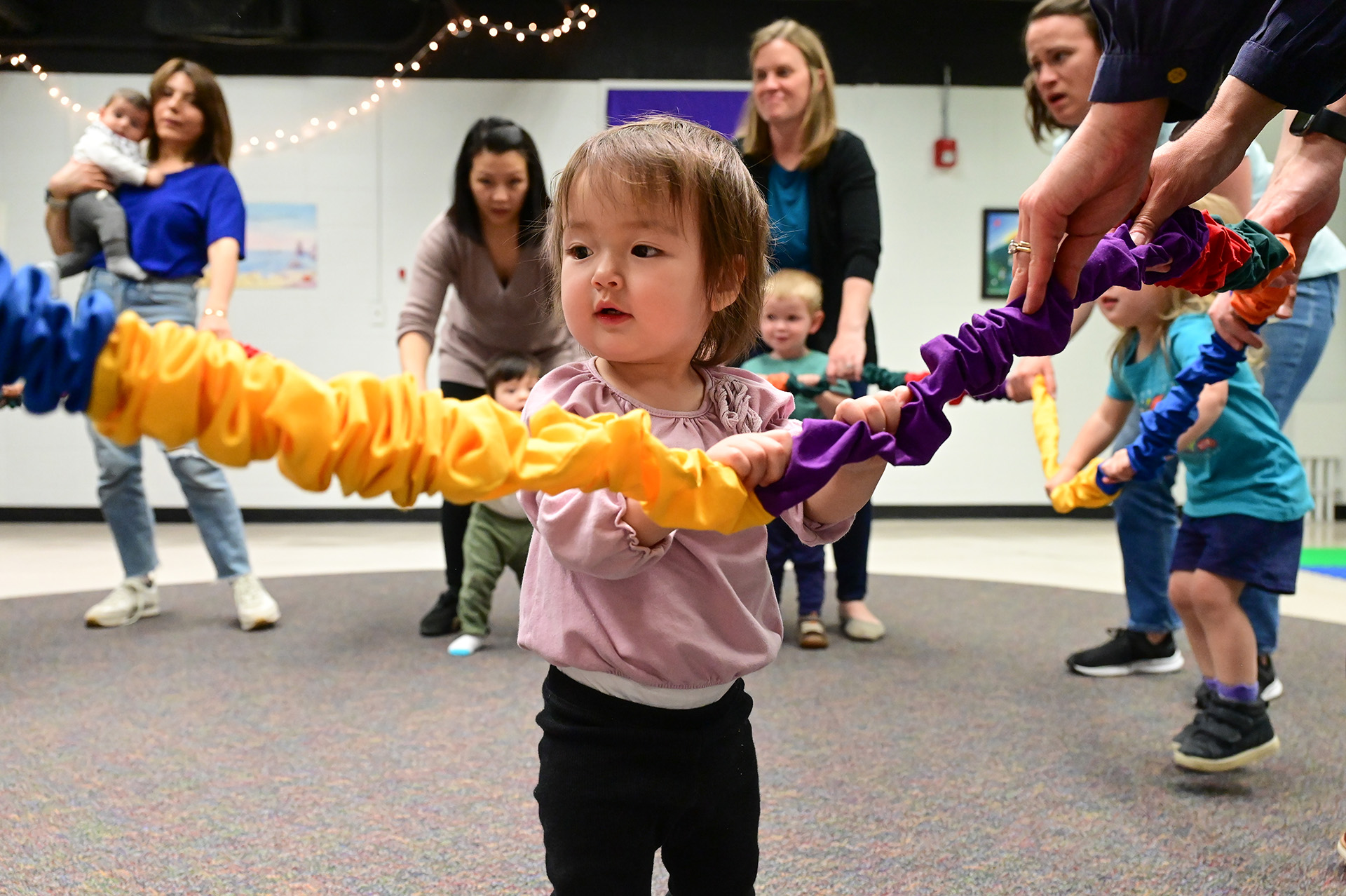
Imagine walking into a Tam Tam class. You can hear singing voices. A baby is bouncing on a grownup’s lap. A toddler is dancing. A preschooler is playing a drum. Someone is laughing. A grownup who insisted before class that they “can’t sing” is singing anyway.
The teacher is guiding the group through a carefully designed sequence of songs, chants, movement activities, instrument play, and musical exploration. But the teacher isn’t performing for the children. The teacher is creating the conditions for everyone to make music together.
You might see:
- Singing: Children and grownups explore melody, rhythm, language, and musical patterns.
- Movement: Everyone bounces, sways, marches, dances, stretches, or otherwise experiences rhythm through the body.
- Instrument play: Children explore drums, shakers, bells, and other instruments through sound, rhythm, timing, and experimentation.
- Listening: Children watch, listen, notice, anticipate, and absorb musical patterns.
- Repetition: Familiar songs return, allowing children to become increasingly comfortable and expressive.
- Play: Music becomes a space for curiosity, imagination, humor, and connection.
And through all of this, there is no requirement that every child do exactly what the teacher does.
What If My Child Doesn’t Participate?
This is one of the most important things for parents to understand about early-childhood music classes.
Participation doesn’t always look like participation.
- A child sitting quietly may be listening.
- A child watching the teacher may be studying the movement.
- A child wandering around the room may still be hearing the music.
- A child who doesn’t sing in class may sing the song at home later that day.
Children don’t always show us what they’re learning immediately. Sometimes they’re busy taking something in. Often they need to experience something repeatedly before they are ready to respond.
At Tam Tam, we don’t require children to sit still, sing on cue, or copy the teacher.
We invite them to explore. The invitation matters more than the performance.
Why Grownup Participation Matters
This deserves its own section because it is central to participatory music-making.
A parent, grandparent, nanny, or other caregiver isn’t simply bringing a child to music class. They are part of the child’s musical environment.
- When you sing, your child hears your voice.
- When you move, your child sees you responding physically to music.
- When you play an instrument, your child sees you experimenting.
- When you laugh and enjoy yourself, your child sees that music is something people can enjoy together.
- And when you participate even though you’re not a trained musician, you’re communicating something especially powerful: You don’t have to be an expert to make music.
That is a message we want every child to carry with them.
Children don’t need perfect musical models. They need musical humans: people who sing, listen, play, make music because music belongs in everyday life.
What Does a Child Actually Learn Through Participatory Music-Making?
Music education for young children is not only about learning songs.
Through repeated musical experiences, children have opportunities to develop musical understanding while also practicing broader skills.
They may learn to:
- anticipate musical patterns and familiar sequences
- experience and respond to a steady beat
- distinguish differences in sound, tempo, dynamics, and movement
- coordinate movement with music
- listen and attend to others
- experiment with sound
- take turns
- respond to social cues
- express themselves in different ways
- persist when something doesn’t work the first time
- experience the pleasure of doing something together
These abilities don’t develop because a teacher lectures a child about them. They develop through experience, repetition, relationships, and play.
That’s one reason a class can look like “just singing and dancing” while a great deal of learning is taking place.
What About Babies?
Babies are musicians, too.
A baby doesn’t need to walk, talk, or hold an instrument to participate in music.
Babies listen, watch, respond to familiar voices, notice rhythm and melody, move their bodies, vocalize, observe the people around them and begin building their own relationship with sound.
For a baby, participation might mean staring at a singing grownup, bouncing on a lap, kicking their legs, making a sound in response to a song, or simply listening.
There is no expectation that a baby will “perform.” The goal is to give babies rich musical experiences while helping their grownups discover just how musical their babies already are.
What About Toddlers and Preschoolers?
Toddlers and preschoolers bring their growing independence, imagination, movement, language, and musical curiosity into the circle.
They may sing, invent movements, experiment with instruments, copy an older child, or decide that the song requires an entirely new dance. All of these behaviors can be part of learning.
Rather than asking young children to behave like miniature adult students, participatory music-making gives them room to experience music through their developing bodies, voices, relationships, and imaginations.
Why Mixed-Age Music-Making Matters
In a mixed-age class, children don’t only learn from the teacher. They learn from one another.
A baby watches a toddler move. A toddler watches an older child play an instrument. A preschooler discovers that a younger child is watching them. Children experience different ways of participating in the same musical environment.
For families with siblings, mixed-age classes also create something especially valuable: a shared musical experience. Instead of separating children into completely different activities, families can make music together.
Bringing the Music Home
Participatory music-making becomes much more powerful when it continues beyond the weekly class.
Tam Tam families receive music and materials designed to make that possible, including an illustrated songbook and access to recordings through the Music Together® app and Family Music Zone.
But you don’t need to create a formal music curriculum at home.
You can simply use the music: Play a song while you’re getting dressed. Sing while you’re making breakfast. Dance in the living room. Listen in the car. Look through the songbook together. Change the words of a familiar song to match something happening in your child’s day. Sing during a transition. Repeat a favorite song. Let your child lead. Make silly music. Let it be imperfect.
The goal isn’t to recreate class at home. The goal is to help music become part of family life.
Music as a Way to Connect
There is another reason we care so much about music-making at home: Music gives families another way to communicate.
Sometimes talking isn’t working. Sometimes a child is tired, frustrated, silly, overstimulated, or simply done with words.
A familiar song can create another route into connection. You can sing instead of speak. Make up a verse about what is happening. Turn cleanup into a song. Use rhythm to make a transition predictable. Dance together when everyone needs to move.
Music doesn’t solve every difficult moment. But it can give families another language for connection, play, and shared attention.
A Musical Environment, Not Just a Music Lesson
The distinction is important. A lesson can be something a child receives. A musical environment is something a child lives in. For young children, we want the latter. We want:
- music to be present in the voices of the adults they love
- rhythm to be something they feel in their bodies
- songs to become familiar
- instruments to invite curiosity
- children to see other children making music
- mistakes to be safe
- experimentation to be welcome
- families to leave class with songs they can carry into the rest of their week.
Because the long-term goal isn’t simply: “My child took music class.”
It’s: “My child knows that music belongs in their life.”
From Weekly Class to Lifelong Relationship With Music
A young child’s earliest musical experiences can shape how they think about themselves as a music-maker. If music is presented as something only talented people can do, children may eventually decide that they aren’t musical. If music is presented as something people make together, children can grow up with a different understanding:
- I can participate.
- I can explore.
- I can make mistakes.
- I can create.
- I can listen.
- I can sing.
- I belong.
That’s the kind of musical identity we want to nurture: Not a performance identity, but rather a participatory one.
How Parents and Caregivers Can Support Musical Development
You don’t need a special room, expensive instruments, or formal musical training.
Start with these simple practices:
Sing to your child. Your voice is one of the most familiar and meaningful sounds in their world.
Sing with your child. Make music something you do together rather than something you provide for them.
Repeat favorite songs. Children often love repetition far more than adults do.
Move. Let your body respond to music.
Play with sound. Tap, clap, shake, hum, whisper, stomp, and experiment.
Follow your child’s interests. If they love one song, sing it again. And again. And again.
Don’t worry about being perfect. Musical connection matters more than performance.
Make music ordinary. The kitchen, stroller, bathtub, car, bedroom, and living room can all be musical spaces.
You don’t need to add another activity to your day. You can make the things you’re already doing more musical.
The Best Way to Understand Participatory Music-Making
You can read about it, learn about child development, think about the role of modeling, repetition, movement, and play — but the easiest way to understand participatory music-making is to experience it.
Come into a room where babies are bouncing, toddlers are dancing, preschoolers are singing, grownups are singing and making music, and a teacher is guiding everyone into a shared musical experience.
That’s participatory music-making. Not watching music happen. Making it happen together.
Come Make Music With Us
At Tam Tam, we believe every child deserves the opportunity to experience themselves as a musician.
Whether you’re bringing a newborn to their first music class, a toddler who loves to dance, a preschooler who is ready to sing out loud, or siblings of different ages, there is a place for you in our musical circle.
You don’t have to be a musician. You just have to show up and make music together.
Tam Tam offers joyful, research-based family music classes for babies, toddlers, preschoolers, and their grownups at locations throughout Brooklyn, as well as participatory music programs for NYC schools and early childhood programs.
Frequently Asked Questions About Participatory Music-Making
Participatory music-making is an approach to music in which people actively make music together rather than having one person perform while everyone else watches. With young children, participation can include singing, movement, instrument play, listening, observing, experimenting, and responding to music in developmentally appropriate ways.
Young children learn through experience, repetition, observation, play, movement, and relationships. Participatory music-making gives them opportunities to actively experience musical patterns and sounds while making music with the adults and children around them.
At Tam Tam, yes. Grownup participation is an important part of the experience. Children benefit from seeing the people they love singing, moving, listening, and making music.
You don’t need musical training to participate. Tam Tam’s classes are designed for ordinary families, not professional musicians. Your willingness to sing, move, listen, and play with your child is what matters.
No. Children participate in different ways and at different times. A child may sing, move, watch, listen, explore, or simply observe. Tam Tam does not require children to perform or copy the teacher.
Babies can participate in music from birth. Tam Tam offers family music classes for children from birth through age five, including baby and mixed-age classes.
Mixed-age classes allow children at different developmental stages to experience music together. Younger children can observe older children, older children can model musical participation, and siblings can share a musical experience.
Families can play class recordings, sing familiar songs during daily routines, dance, explore instruments, make up new lyrics, and repeat favorite songs. The goal isn’t to reproduce a formal lesson at home; it’s to make music part of everyday family life.
In a performance, children or musicians perform for an audience. In participatory music-making, children and adults are invited to actively make music together. The emphasis is on engagement, exploration, connection, and musical development rather than performance.
Tam Tam’s family classes use the research-based Music Together® curriculum, which provides a rich repertoire of songs and developmentally appropriate musical experiences for young children and their grownups.
Tam Tam offers family music classes at locations throughout Brooklyn and participatory music programs for NYC schools and early childhood programs.
About this resource
This guide was created by Tam Tam, a Brooklyn-based music education program serving children, families, and schools.
About Tam Tam
Tam Tam is a Brooklyn-based music education program founded in 2015 by Jelena Karanovic. Tam Tam offers research-based family music classes and school music programs rooted in active participation, grownup involvement, community, and the belief that every child is musical.
Last reviewed: August 2026