
(The Surprising Connection Between Music, Play, and Math)
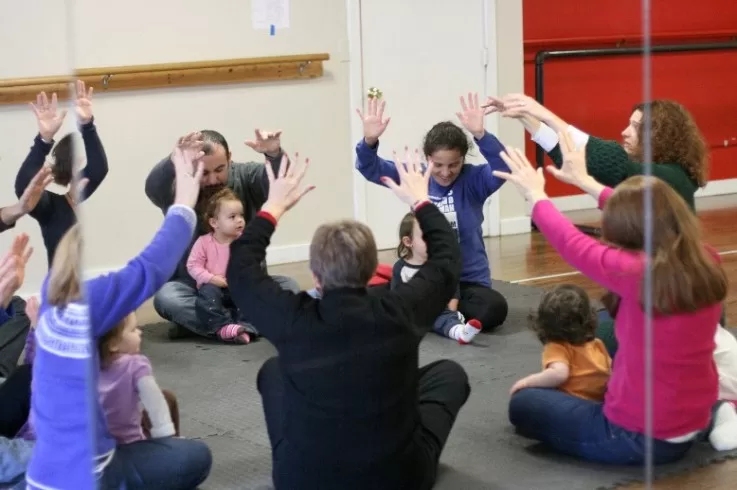
At Tam Tam, we love the joyful chaos of class: the burps (and polite “Excuse me!”), the lip brrrrrs, the tongue rolls, the squeaky voices, and of course, all that finger play! It might look like pure silliness–and that’s part of the magic–but these playful musical moments are also building powerful brain connections that support your child’s growth from infancy through kindergarten and beyond.
Finger Play: Small Movements, Big Development
When your child wiggles, taps, or “flies” their fingers along to a song, they’re strengthening something called finger perception: the brain’s ability to recognize and distinguish each finger without looking. This skill develops early and continues to refine through sensory and musical play.
Why does it matter? Research shows that finger perception is linked to mathematical understanding. In one study, neuroscientists found that when children aged 8–13 solved complex subtraction problems, the somatosensory finger area of the brain became active even though they weren’t actually using their fingers! The same area lit up even more with harder problems that required more number manipulation (Boaler, Limitless Mind, 2019; see also Soylu et al., Frontiers in Human Neuroscience, 2018).
In other words: children’s early experiences with their fingers shape how they later think about numbers. Counting on fingers isn’t just a stepping stone: it’s a deep cognitive support that remains important long after children stop doing it physically.
Music and Movement: Whole-Body Learning
Music-making gives children endless opportunities to develop this kind of embodied understanding. When we tap, clap, and dance to a beat, we’re engaging motor, auditory, and emotional networks all at once, providing what neuroscientist Dr. Laurel Trainor calls “a superfood for the brain.” Studies show that musical rhythm and movement activities enhance language skills, self-regulation, and executive function (Trainor & Corrigall, Annals of the New York Academy of Sciences, 2010; Williams et al., Developmental Science, 2015).
Even very young infants show brain synchronization to rhythmic movement and benefit socially and emotionally from these shared experiences. When parents join in fingerplays like Sandpiper or Rocketship, children experience the joy of coordinated play, while also literally building neural pathways for communication, cooperation, and cognition.
Overall, “musicians’s achievement in higher mathermatics, a relationship that has been noted for many years, is now thought to be due to their opportunities for developing good finger perception.” (Boaler, Limitless Mind, p. 105; Beilock, How the Body Knows Its Mind).
At Home: Keep the Finger Fun Going
Here are a few ways to keep supporting your child’s development through music and play:
- Sing and move together daily: even a few minutes makes a difference.
- Try fingerplay songs from class (“froggies,” “sandpipers,” or “rocketships”) and make up new ones together!
- Encourage your child to invent their own gestures for familiar songs.
- Use everyday moments (washing hands, putting on gloves, eating snacks) as playful opportunities to name and move each finger.
So the next time you see your child wiggling, tapping, or burping along in class, know that it’s not just cute: it’s serious brain-building disguised as play.
References
- Beilock, S. (2015). How the Body Knows Its Mind: The Surprising Power of the Physical Environment to Influence How Your Think and Feel. Simon and Schuster.
- Boaler, J. (2019). Limitless Mind: Learn, Lead, and Live Without Barriers. HarperOne.
- Soylu, F., Lester, F. K., & Newman, S. D. (2018). “You can count on your fingers: The role of fingers in early mathematical development.” Frontiers in Human Neuroscience, 12, 1–11.
- Trainor, L. J., & Corrigall, K. A. (2010). “Music acquisition and effects of musical experience.” Annals of the New York Academy of Sciences, 1169(1), 130–142.
- Williams, K. E., Barrett, M. S., Welch, G. F., Abad, V., & Broughton, M. (2015). “Associations between early shared music activities in the home and later child outcomes: Findings from the Longitudinal Study of Australian Children.” Developmental Science, 18(5), 697–713.